Loading destination…
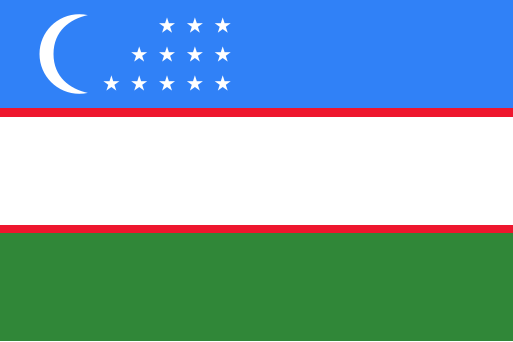
Uzbekistan eSIM
5 datapaket · från 66,50 kr · omedelbar QR via e-post
Välj ditt paket
Reser ni i grupp? Köp en eSIM till alla i samma beställning så dras rabatten automatiskt — ingen kod behövs. Se gruppriser
5 datapaket · från 66,50 kr · omedelbar QR via e-post
Reser ni i grupp? Köp en eSIM till alla i samma beställning så dras rabatten automatiskt — ingen kod behövs. Se gruppriser
Streaming, delning, tung användning
121,50 kr
11,65 kr/GB
Köp →
Ansluter automatiskt till den starkaste signalen över Beeline.
Installation
Ställ in ditt eSIM innan du reser — det tar ungefär en minut. Skanna en gång, slå på det när du anländer, och du är online.
På iPhone (iOS)
På Android
7 datapaket för Uzbekistan, från 3 till 20 GB. Giltigheten sträcker sig från 1 dag till 30 dagar. Ingen av dessa fungerar med 5G — Uzbekistan har endast LTE på de nätverk vi säljer. Vi vill hellre berätta det här än att du upptäcker det vid ankomst.
5 paket kan fyllas på utan att installera ett andra eSIM. Paketen fungerar med Beeline.
Räknat från vår live-katalog, inte en marknadsföringssiffra — listan över paket ovanför det här avsnittet är samma data.
Inget regionalt paket täcker Uzbekistan — här är ett paket för ett enda land det enda alternativet, och det är ändå oftast billigare.
Ett rese-eSIM för Uzbekistan är ett digitalt SIM som din mobil laddar ner — inget plastkort, ingen upphämtningsdisk på flygplatsen. Du köper online, trycker på installationslänken vi mejlar dig (en QR-kod följer med i samma mejl), och det installerar en andra linje vid sidan av ditt befintliga SIM. Det förblir vilande tills du anländer till Uzbekistan, sedan ansluter det automatiskt till Beeline på LTE. Ditt hemnummer fortsätter fungera för samtal och sms; eSIM-kortet hanterar helt enkelt din data.
Kartor, meddelanden och samåkningsappar drar lite — ungefär 300–500 MB om dagen. Lägg till foton, sociala medier och en och annan video så är du närmare 1 GB om dagen. För en veckas resa är ett 5 GB-paket bekvämt; för två veckor, delning eller tung användning, välj 10 GB eller mer, eller ett påfyllningsbart paket som du kan ladda på språng. Uzbekistan-paket börjar på 66,50 kr över 5 storlekar, med priset per GB visat på varje så att rätt val är uppenbart.
Bara paketpriset. Inom EU gäller surfa-som-hemma och ditt vanliga abonnemang räcker; utanför EU tar operatörens utlandstaxa vid, och den räknas per megabyte. Ett rese-eSIM för Uzbekistan är ett lokalt datapaket, inte roaming via din operatör hemma — du betalar summan du ser i förväg. Ställ in eSIM-kortet som datalinje och slå av dataroaming på ditt vanliga SIM, så kommer det inga överraskningar när du är hemma igen. Full återbetalning när som helst innan du installerar, så du riskerar ingenting genom att köpa i förväg.
Plov
Rice cooked with lamb, carrot, cumin and often chickpeas, quail eggs or raisins in a wide kazan over fire. Every city has its own version and the tradition is on the UNESCO intangible heritage list. Cooked in the morning and sold until the pot is empty.
The Central Asian Plov Centre in Tashkent, where it is made in cauldrons the size of a bath. Arrive before one in the afternoon.
Somsa
Pastry parcels of minced lamb, onion and fat, slapped onto the inside wall of a clay tandyr and baked until the base blisters. Pumpkin versions appear in autumn.
Bakeries and street tandyrs everywhere; buy them the moment they come out.
Non
Round flatbread stamped in the centre with a chekich, a nail-studded seal that keeps the middle thin. Never placed upside down and never thrown away — bread carries real weight here.
Siyob bazaar in Samarkand, whose bread is claimed to keep for weeks.
Lagman
Hand-pulled noodles served in a spiced broth with lamb and peppers, or fried with them. The dough is stretched and folded repeatedly in front of you in the better places.
Uyghur and Dungan cafes; the Fergana valley versions are the ones to seek out.
Manti
Large steamed dumplings of minced lamb and onion, sometimes pumpkin, served with sour cream. Steamed in stacked trays over a pot.
Bazaar kitchens and traditional restaurants.
Shurpa
A clear mutton soup with whole chunks of vegetable and a good deal of fat floating on top, served with bread and fresh herbs. Breakfast as often as lunch.
Chaikhanas and roadside cafes on every intercity route.
Norin
Hand-cut noodle strips tossed cold with shredded horse meat and kazy sausage. A Tashkent speciality, served at celebrations, and unlike anything else on the menu.
Traditional restaurants in Tashkent; ask, because it is not always listed.
Dimlama
Meat, potato, cabbage, carrot and tomato layered in a sealed pot and stewed in their own liquid until everything collapses together.
Home-style restaurants and guesthouses.
Melons
Uzbek melons were traded across Asia for centuries and are still a point of national pride, particularly the long Khorezm varieties. Sold in pyramids at every bazaar in late summer.
Chorsu bazaar in Tashkent and the roadside stands on the Khorezm road, from July to autumn.
Green tea in a chaikhana
Kok choy poured, returned to the pot and poured again three times before it is served, in a piala bowl filled only part way — a full bowl is a hint that you should leave. The chaikhana is the social institution, not the drink.
Any chaikhana; the ones around Lyabi-Hauz in Bukhara sit under old plane trees.
RegistanSamarkand
Three madrasas facing a single square in tiled blue and gold, built across two centuries. One of them carries tigers and human faces in its mosaic, which orthodox Islamic decoration would not normally allow.
half a day
Shah-i-ZindaSamarkand
A narrow lane of mausoleums climbing a hillside, each face entirely tiled, built for Timur's family and commanders. The most concentrated tilework in the country and best in early light.
2 hours
Gur-e-Amir and Bibi-KhanymSamarkand
Timur's own tomb under a fluted turquoise dome, and the enormous congregational mosque built for his wife that began collapsing almost as soon as it was finished. The Siyob bazaar sits beside the latter.
half a day
Bukhara old cityBukhara
A living old town rather than a monument park: the Kalyan minaret that Genghis Khan reportedly spared, the Ark fortress, the domed trading arcades and the Lyabi-Hauz pool with its chaikhanas.
two days
Itchan KalaKhiva
A walled inner city of mud-brick and tile that you enter through a gate and do not need to leave — madrasas, a squat unfinished minaret and city walls you can walk. It feels staged in daylight and much better at dawn or after dark.
two days
TashkentTashkent
The capital, largely rebuilt after the 1966 earthquake, with a metro whose stations were designed as public architecture and could not legally be photographed until 2018, the sprawling Chorsu bazaar under its blue dome, and the Khast Imam complex holding a Quran manuscript claimed as one of the world's oldest.
two days
ShakhrisabzShakhrisabz
Timur's birthplace, over the mountains from Samarkand, where the two surviving portal fragments of the Ak-Saray palace give a sense of a scale that no longer exists anywhere else.
a day
Nuratau mountains and AydarkulNurata
Village homestays in the foothills between Samarkand and Bukhara, walking between hamlets, and a yurt camp on the shore of a lake that only exists because a Soviet dam overflowed in the 1960s.
two days · boka i förväg
Fergana ValleyMargilan, Rishtan and Kokand
The fertile, conservative and densely populated east: silk woven into ikat patterns at Margilan, blue-glazed ceramics at Rishtan, and the Khan's palace at Kokand. Reached through the Kamchik pass.
two days
Nukus and MuynakKarakalpakstan
The Savitsky Museum in Nukus holds a large collection of banned Soviet avant-garde painting, hidden in the desert precisely because nobody was watching. North of it, Muynak's fishing boats sit rusting on sand where the Aral Sea used to be.
two days
Afrosiyob high-speed train
The fast service linking Tashkent, Samarkand and Bukhara, and the single best thing about travelling here. Seats are reserved and it sells out days in advance in season, so book as soon as your dates are fixed.
low
Sleeper train
Overnight services run from Tashkent to Urgench for Khiva, and on other long routes, in four-berth and two-berth compartments. Slower than flying but it saves a night's accommodation and crosses the desert while you sleep.
low
Shared taxi
Cars leaving when full from set stands at the edge of each city, covering every route the trains do not. Agree the price for your seat, or pay for all four if you want to leave immediately.
low
Tashkent metro
Cheap, frequent and worth riding for the stations themselves, which were built as showpieces. Paid by card or token at the barrier.
very low
Domestic flights
Uzbekistan Airways connects Tashkent with Nukus, Urgench and Termez in about an hour and a half, against a day or more by road.
moderate
Samåkningstjänster
Yandex Go, MyTaxi
Both work well in Tashkent, Samarkand and Bukhara and are very cheap. Outside them, informal taxis are the norm — raising a hand at the roadside will stop an ordinary driver, which is completely usual here but means agreeing a price through the window before you get in.
Att betala
Grunderna
| New Year | 1 January | Public holiday; the main secular celebration of the winter. |
| Day of Defenders of the Motherland | 14 January | Public holiday, low impact on travel. |
| International Women's Day | 8 March | Widely observed public holiday; restaurants busy and flower sellers on every corner. |
| Navruz | 21 March | The spring new year and the biggest holiday of the year. Sumalak is cooked overnight in communal cauldrons, streets fill with performances, and domestic travel peaks around it. |
| Ramazon Hayit | Eid al-Fitr, moving about eleven days earlier each year | Public holiday at the end of the fasting month. Family visiting means busy roads and quiet restaurants on the day itself. |
| Qurbon Hayit | Eid al-Adha, moving about eleven days earlier each year | Public holiday with heavy intercity travel and full trains. |
| Day of Remembrance and Honour | 9 May | Public holiday commemorating the war dead; ceremonies in Tashkent. |
| Independence Day | 1 September | Marks 1991. Large staged celebrations in Tashkent and a public holiday nationwide. |
Rörliga datum — vilken dag de infaller ändras år från år.